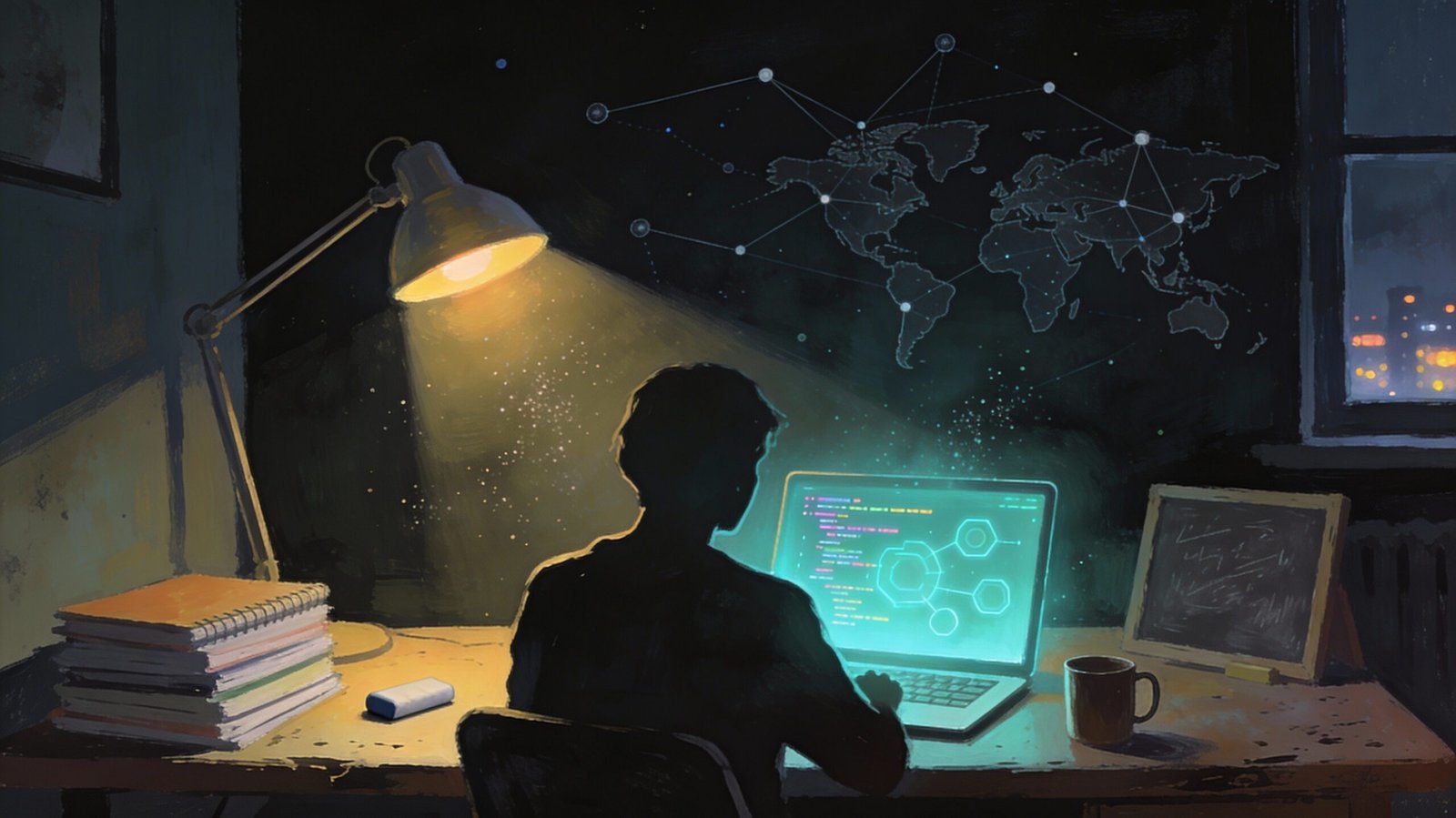
From School Director to Coding Educator: How Quincy Larson Built the World’s Largest Free Programming Platform
Quincy Larson started freeCodeCamp in a closet. Not a fancy home office. A literal closet in his San Francisco Bay Area apartment.
He was 31 years old. He worked as a school director. He had no formal tech background. And he was about to change how millions of people learn to code.
THE UNLIKELY BEGINNING
Quincy’s path to tech looked nothing like the typical Silicon Valley story. He dropped out of high school. He worked at Taco Bell. He mopped grocery store floors before dawn. Eventually he earned his GED and went to the cheapest state university he could find.
After college, he moved to China. He spent six years there teaching English and running schools. He learned Mandarin. He got his graduate degree entirely in Chinese. He managed 25 employees across schools in the US and China.
This is where the spark happened.
His teachers spent hours filling out government web forms. They fought with spreadsheets. They did mindless data entry when they should have been teaching students face to face.
Quincy got frustrated. He started Googling “how to automate repetitive tasks.” He taught himself Python and JavaScript. He built simple tools to eliminate the busywork.
Student satisfaction jumped. Teacher morale improved. The whole school culture shifted.
One person learning basic code made this much difference.
Quincy thought: What if I learned to code properly? What if I helped others learn so they could do this in their own organizations?
The question changed his life.
THE NINE MONTH GRIND
Learning to code as a working adult with no computer science background is brutal.
Quincy quit his job. He spent nine months teaching himself. He went to every hackathon he could find. He sat alone in hackerspaces while everyone else worked. He took online courses from Stanford and MIT. He did coding exercises until his eyes blurred.
The self-doubt was constant. “Maybe I’m not smart enough. Maybe my lack of math knowledge is holding me back.” Every error message felt like proof he didn’t belong.
But he pushed through.
After nine months, he landed his first software engineering job. Working on a real team with real codebases taught him more in one year than all his self-study combined.
He freelanced on the side. He built websites for small businesses. After two years as a professional developer, he felt ready for his original vision.
He didn’t want to build software for schools. He wanted to teach others to code so they could build their own solutions.
WEEKEND LAUNCH
In October 2014, Quincy and two friends shut down their failing startup. Over one weekend, he coded the first version of freeCodeCamp.
The platform was bare bones. Users signed in. They worked through coding challenges. They marked them complete. They earned certifications.
He pushed it live and started tweeting.
Within the first month, 340 people signed up. Forty completed the initial challenges. Seven nonprofits volunteered to host student projects. Ten people hung out in the chatroom at any time. Developers on six continents were pair programming together.
The model was different from other bootcamps. Students would get skills, portfolio projects, an alumni network, and real world experience building software for nonprofits who needed help but couldn’t afford market rates.
Quincy’s approach broke from typical coding education. Students didn’t jump between random tutorial sites. They followed one linear path. No confusing prerequisites. No circular dependencies.
Students didn’t watch videos. They spent 100% of their time coding. Interactive challenges ran in the browser. No local setup. No installation headaches. Automated tests gave instant feedback.
THE COST OF FREE
Building a nonprofit education platform required sacrifice.
Over three years, Quincy poured $150,000 of personal savings into freeCodeCamp. This was money he and his wife Jade had saved for a house down payment in the Bay Area.
For years, he took no salary. When he finally paid himself in 2018, he earned $60,000. Less than he made as a teacher in 2010. Individual software engineers in Silicon Valley often earn more than freeCodeCamp’s entire annual budget.
His wife Jade made the gamble survivable. She worked full time in accounting at a software company. Her job provided health insurance worth tens of thousands per year.
Their daughter Jocelyn was born in late 2014, eleven months after freeCodeCamp launched. They left expensive San Francisco for Oklahoma City, one of the cheapest metros in the US.
Quincy admits how close they came to failure. “If my daughter had been born one year earlier, freeCodeCamp wouldn’t exist. I would have had to give up my dreams and get a job to support our family.”
Timing, savings, and a spouse willing to carry the financial load for years made his risk possible. Most aspiring nonprofit founders don’t have these luxuries.
SCALING ON FUMES
What happened next defied startup logic.
freeCodeCamp didn’t raise venture capital. It didn’t hire professional fundraisers. It didn’t run ads or sell user data.
The model: If the platform genuinely helps people, some percentage will donate to keep it alive.
The model worked, barely.
In 2019, freeCodeCamp’s entire budget was $373,000. By 2020, it grew to $498,521. In 2021, it reached $754,030.
These numbers are tiny compared to for-profit bootcamps charging $15,000 to $20,000 per student. Yet freeCodeCamp was delivering billions of minutes of instruction.
How? Obsessive efficiency. The organization runs on donations from roughly 11,000 people contributing around $5 per month. Every dollar gets scrutinized. Quincy personally oversees the budget. He refuses to hire expensive consultants.
The full time staff stayed tiny. Just seven people as of 2019. The rest of the work comes from thousands of volunteer contributors worldwide who build curriculum, moderate forums, review code, and produce tutorials because they believe in the mission.
By 2021, people spent 2.1 billion minutes learning on freeCodeCamp. The equivalent of 4,000 years of human effort. In 2022, this doubled to 4 billion minutes. As of late 2025, more than half a million people use the platform daily.
A NEW WAY TO LEARN
Traditional computer science education follows a pattern: professors lecture, students take notes, everyone takes tests.
freeCodeCamp inverted this model.
Learners spend zero time watching lectures during the core curriculum. They spend 100% of their time writing code. Each challenge presents a problem and a test suite. Learners write code until all tests pass, then move to the next challenge.
Feedback loops are instant. Not days later graded exams. Sub millisecond responses.
The curriculum grew through community contributions and direct learner feedback. By 2025, the platform offered a 3,000 hour curriculum spanning 12 certifications. Everything from responsive web design and JavaScript algorithms to Python machine learning, data visualization, and English for developers.
The platform emphasizes project based learning. Certifications require completing five substantial portfolio projects. Not multiple choice tests. Learners build real applications. Games, APIs, data dashboards, interactive tools. Things they show employers.
This philosophy comes from Quincy’s own painful learning journey. He wished someone had given him clear, cumulative projects instead of scattered tutorials leaving him directionless.
The platform also makes community a first class feature, not an afterthought. The freeCodeCamp forum became the second largest programming help community on the internet, trailing only Stack Overflow. A Discord server buzzes with real time conversation. Learners ask questions, pair program, and participate in challenges like 100DaysOfCode. City based study groups and meetups sprung up worldwide.
THE NUMBERS
By any measure, freeCodeCamp’s impact is staggering.
Over 400,000 people landed their first developer job after using the platform. At least 40,000 explicitly credit a freeCodeCamp certification as the turning point in their job search. More than 217,000 alumni list freeCodeCamp credentials on LinkedIn. They work at Apple, Google, Microsoft, startups, freelance consultancies, and nonprofits. Graduates span six continents.
The YouTube channel became the largest programming focused channel on the planet. 11.3 million subscribers. Over 915 million video views as of November 2025. It hit 10 million subscribers in September 2024, a decade after Quincy first started uploading tutorials.
In 2025 alone, the community published 129 free video courses, 45 full length books and handbooks, 452 programming tutorials, and 50 podcast episodes.
The open source codebase reflects global collaboration. In 2025, contributors merged 4,279 commits. More than 611 volunteers contributed meaningfully. Over freeCodeCamp’s existence, learners earned more than 300,000 certifications, representing millions of cumulative hours of study.
WHO USES FREECODECAMP
About 60% of learners have English as a second language. Roughly 22% are ethnic minorities in their home countries. Seventy five percent live in large cities, but a meaningful cohort lives in rural and underserved areas. About 82% have no children, suggesting many are young adults or career switchers with time to invest.
Significantly, 17.5% of learners lack high speed internet at home. This underscores freeCodeCamp’s design choices: lightweight, browser based tools working on older hardware and slower connections. A learner in rural India or sub Saharan Africa isn’t locked out by infrastructure gaps.
WHAT MAKES IT DIFFERENT
Countless coding education platforms exist. Codecademy, Udemy, Coursera, Pluralsight, LinkedIn Learning. The list goes on.
freeCodeCamp carved out a unique position by rejecting the trade offs others accepted.
It’s genuinely free. Not “free trial then paywall.” Not “free tier with crippled features.” Completely free, forever, with no catch. Quincy has repeatedly turned down offers to monetize through ads, affiliate links, or selling learner data. The platform survives on donations. If donations fall short one year, he dips into reserves or tightens the budget further.
It’s nonprofit by design. freeCodeCamp is a 501(c)(3) public charity with Platinum transparency ratings from GuideStar. Its financials are fully public. Every dollar donated goes toward curriculum development, server costs, and a skeleton crew of full time staff. Quincy’s own compensation is modest and disclosed on annual tax returns.
It prioritizes long term depth over quick wins. Most bootcamps promise job ready skills in 12 to 16 weeks. freeCodeCamp’s full curriculum is 3,000 hours. Roughly 18 months of full time study, or several years part time. It’s not designed to optimize for fast certification counts. It’s designed to build genuine, durable competence.
It’s community first. Unlike platforms where learners are isolated consumers, freeCodeCamp treats community as infrastructure. The forum, Discord, study groups, and open source contribution opportunities aren’t extras. They’re core to the learning model. This mirrors Quincy’s belief, informed by his years as a teacher, where peer learning and accountability are as important as curriculum quality.
It embraces transparency about difficulty. Quincy never promised learning to code would be easy. He acknowledges the grind, the frustration, the impostor syndrome. In interviews and essays, he shares his own struggles openly, normalizing the experience of feeling lost and incompetent. This honesty builds trust and resilience in learners who might otherwise quit when the path gets hard.
LESSONS FROM A DECADE
Quincy’s reflections on building freeCodeCamp offer a masterclass in mission driven work.
Adults learn differently and often better than children. Quincy emphasizes adults bring existing knowledge networks and life experience to learning. A 30 year old career switcher maps new coding concepts onto familiar mental models, making abstract ideas concrete faster than a teenager with no professional context.
Project based learning beats tutorial hell. “Tutorial hell” is the trap of endlessly consuming instructional content without building anything original. Learners get comfortable following step by step guides but freeze when faced with a blank screen. freeCodeCamp forces learners to build 100+ projects, each slightly harder than the last, scaffolding confidence through cumulative complexity.
Community is mission critical, not an afterthought. Early on, Quincy noticed learners who connected with others through pair programming, forums, or local meetups had dramatically higher completion and job placement rates than isolated learners. Community transforms learning from a solitary slog into a shared journey. It provides accountability, debugging help, motivation during plateaus, and job referrals.
Transparency and humility build trust. Quincy’s willingness to share freeCodeCamp’s budget, his own salary, the organization’s successes and failures creates a bond with learners and donors. People give because they trust their money is being used wisely. Learners persist through hard curriculum because they trust Quincy isn’t selling them snake oil. He’s sharing the path he wishes existed when he was struggling.
Scale is a choice, not an inevitability. freeCodeCamp could have pursued venture funding, hired aggressively, and chased explosive growth metrics. Quincy chose not to. He accepted slower growth, smaller budgets, and constant stress of donor dependent revenue because the alternative would have compromised the mission. No ads. No paywalls. No selling out.
THE ROAD AHEAD
As freeCodeCamp enters its second decade, Quincy’s ambitions remain grounded and expansive.
The platform continues evolving its curriculum. Major updates in 2024 consolidated certifications into a comprehensive Certified Full Stack Developer path and added advanced coursework in React, performance optimization, and testing. New language tracks in Spanish and Chinese are in active development, acknowledging English proficiency remains a barrier for hundreds of millions of potential learners.
There’s talk of formal accreditation. Quincy has floated the idea of freeCodeCamp pursuing recognition as a degree granting institution, though he’s candid this process could take 10 to 15 years of data collection and bureaucratic navigation.
More immediately, the organization is expanding its book and video production, aiming to become the definitive free resource for learning to code and advancing through senior developer and specialized roles.
WHY THIS MATTERS
Quincy Larson’s story matters not because he’s a singular genius who cracked an unsolvable problem. He’s proof mission driven persistence reshapes industries.
He was a high school dropout, a school director who learned to code in his thirties, a guy who spent nine months grinding through tutorials in lonely hackerspaces before anyone would hire him. He didn’t come from money. Didn’t have Stanford on his resume. Didn’t raise millions in VC funding.
He cared enough to build the ladder he wished had been there when he was climbing.
freeCodeCamp has now helped 400,000 people get their first tech jobs. These are 400,000 families with more financial stability. 400,000 people who discovered they could build things before they existed. 400,000 career switchers who didn’t take on crippling student debt or quit their jobs for expensive bootcamps.
More broadly, Quincy’s work challenges the narrative where quality education must be expensive, expertise requires gatekeeping, learning is a commodity to be extracted for profit. freeCodeCamp exists as a counter model: a nonprofit, community powered, radically transparent platform treating learners as partners, not customers.
It’s messy, underfunded, and running on fumes half the time. It’s also changing the world.
For educators, founders, and career switchers alike, the lesson is clear: If you’ve lived through a problem, you’re qualified to help solve it.
Quincy Larson didn’t wait for someone else to fix coding education. He built the school he needed, invited everyone in, and refused to charge admission.
Ten years later, millions are walking through those doors.
This isn’t an inspiring story. It’s a blueprint.